| |
Jack
London's
Description of the View from Sonoma Mountain
 Editor's
note: In the early 1900s, writer Jack London owned and lived
on a ranch near Glen Ellen which extended to the top of Sonoma
Mountain. Much of this ranch now makes up Jack
London State Historic Park. The "southern edge
of the peak" mentioned in this excerpt would be at or very
near Lafferty's upper meadow. Editor's
note: In the early 1900s, writer Jack London owned and lived
on a ranch near Glen Ellen which extended to the top of Sonoma
Mountain. Much of this ranch now makes up Jack
London State Historic Park. The "southern edge
of the peak" mentioned in this excerpt would be at or very
near Lafferty's upper meadow.
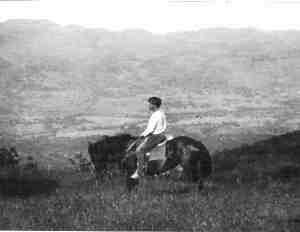
There were no houses in the
summit of Sonoma Mountain, and, all alone under the azure
California sky, he reined in on the southern edge of the
peak. He saw open pasture country, intersected with wooded
canons, descending to the south and west from his feet,
crease on crease and roll on roll, from lower level to lower
level, to the floor of Petaluma Valley, flat as a
billiard-table, a cardboard affair, all patches and squares
of geometrical regularity where the fat freeholds were
farmed. Beyond, to the west, rose range on range of
mountains cuddling purple mists of atmosphere in their
valleys; and still beyond, over the last range of all, he
saw the silver sheen of the Pacific. Swinging his horse, he
surveyed the west and north, from Santa Rosa to St. Helena,
and on to the east, across Sonoma to the chaparral-covered
range that shut off the view of Napa Valley. Here, part way
up the eastern wall of Sonoma Valley, in range of a line
intersecting the little village of Glen Ellen, he made out a
scar upon a hillside. His first thought was that it was the
dump of a mine tunnel, but remembering that he was not in
gold-bearing country, he dismissed the scar from his mind
and continued the circle of his survey to the southeast,
where, across the waters of San Pablo Bay, he could see,
sharp and distant, the twin peaks of Mount Diablo. To the
south was Mount Tamalpais, and, yes, he was right, fifty
miles away, where the draughty winds of the Pacific blew in
the Golden Gate, the smoke of San Francisco made a low-lying
haze against the sky.
"I ain't seen so much country all
at once in many a day," he thought aloud.
From Part II, Chapter 8 of Burning Daylight,
serialized in The New York Herald, June-August, 1910.
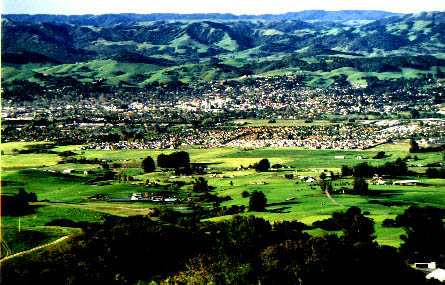
Spring view today from Lafferty Ranch on
Sonoma Mountain
toward Petaluma and beyond. Photograph by Scott Hess.
Robert Louis Stevenson's description of ascending
a nearby Sonoma or Napa county ridge
A rough smack of
resin was in the air, and a crystal mountain purity. It came
pouring over these green slopes by the oceanful. The woods
sang aloud, and gave largely of their healthful breath.
Gladness seemed to inhabit these upper zones, and we had
left indifference behind us in the valley. "I to the hills
lift mine eyes!" There are days in a life when thus to climb
out of the lowlands, seems like scaling heaven.
From Chapter II, "First Impressions of
Silverado" of Silverado
Squatters by Robert Louis Stevenson
|
Henry David Thoreau
on our need to walk in nature
 At present, in
this vicinity, the best part of the land is not
private property; the landscape is not owned, and
the walker enjoys comparative freedom. But possibly
the day will come when it will be partitioned off
into so-called pleasure-grounds, in which a few will
take a narrow and exclusive pleasure only--when
fences shall be multiplied, and man-traps and other
engines invented to confine men to the PUBLIC road,
and walking over the surface of God's earth shall be
construed to mean trespassing on some gentleman's
grounds. To enjoy a thing exclusively is commonly to
exclude yourself from the true enjoyment of it. Let
us improve our opportunities, then, before the evil
days come. At present, in
this vicinity, the best part of the land is not
private property; the landscape is not owned, and
the walker enjoys comparative freedom. But possibly
the day will come when it will be partitioned off
into so-called pleasure-grounds, in which a few will
take a narrow and exclusive pleasure only--when
fences shall be multiplied, and man-traps and other
engines invented to confine men to the PUBLIC road,
and walking over the surface of God's earth shall be
construed to mean trespassing on some gentleman's
grounds. To enjoy a thing exclusively is commonly to
exclude yourself from the true enjoyment of it. Let
us improve our opportunities, then, before the evil
days come.
From
"Walking" by
Henry David Thoreau
So,
if there is any central and commanding hilltop, it
should be reserved for the public use. Think of a
mountaintop in the township, even to the Indians a
sacred place, only accessible through private
grounds. A temple, as it were, which you cannot
enter without trespassing—nay, the temple itself
private property and standing in a man’s cow-yard,
for such is commonly the case. ... That area should
be left unappropriated for modesty and reverence’s
sake—if only to suggest that the traveller who
climbs thither in a degree rises above himself, as
well as his native valley, and leaves some of his
grovelling habits behind.
I know it is a mere
figure of speech to talk about temples nowadays,
when men recognize none and associate the word with
heathenism. Most men, it appears to me, do not care
for Nature and would sell their share in all her
beauty for as long as they may live for a stated and
not very large sum. ... It is for the very reason
that some do not care for these things that we need
to combine to protect all from the vandalism of a
few.
... I
think that each town should have a park, or rather a
primitive forest, of five hundred or a thousand
acres, either in one body or several—a common
possession forever, for instruction and recreation.
... It frequently happens that what the city prides
itself on most is its park, those acres which
require to be the least altered from their original
condition.
From
"Wild
Fruits" by Henry David Thoreau
|
 |
|

